
Dr. Nino Antulov-Fantulin, Co-Founder and Head of Research at Aisot Technologies, on what AI in investment research looks like and where the field is heading.
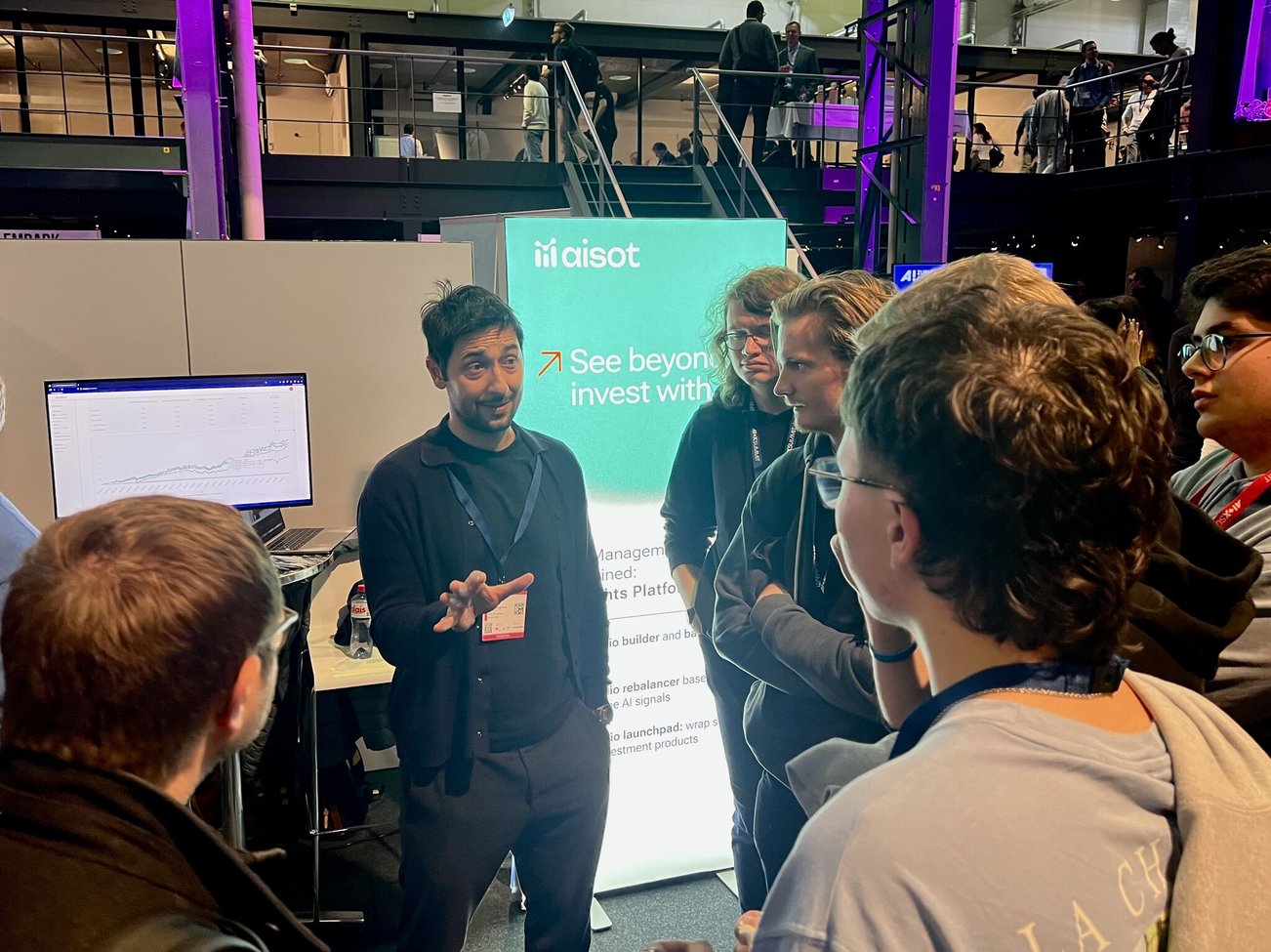
For most investment teams, the bottleneck is not insight. It is bandwidth. We spoke with Dr. Nino Antulov-Fantulin about how AI is changing that equation.
Where does AI belong in an investment research workflow?
In the synthesis layer, first. The volume of information relevant to any investment decision, earnings data, macro releases, news, sentiment shifts, has grown far beyond what any research team can process manually. AI handles that continuously and across a much broader universe than analysts can cover on their own, surfacing what is relevant with enough context to evaluate quickly. What used to take a morning now takes minutes.
But the more important change is what happens next. When the synthesis layer is handled, analyst capacity shifts to the work that actually requires judgment: forming a view, interrogating assumptions, understanding the second and third-order implications of a macro development. The research process does not get shorter. It gets deeper.
What role do language models play specifically?
A specific one: processing financial news in real time to produce sentiment signals. On a typical day, news sentiment accounts for around 10 to 15 percent of the return forecast of our AI-driven quantitative expected return models. On high-information days — a central bank decision, a major earnings surprise, a geopolitical shock — that contribution can rise to 30 to 50 percent.
Why combine that with a quantitative framework rather than let the LLM signal stand on its own?
Sentiment is a meaningful input, not a standalone forecast. We embed it within a quantitative framework grounded in financial theory, not the other way around. That framework is what keeps it disciplined and, just as importantly, what keeps it auditable: every signal we generate has a traceable methodology, validated out of sample and version-controlled. A portfolio manager acting on it can explain what drove it and what its limitations are, because it sits inside a process that is traceable and validated, not a black box.
What about investment idea generation? That feels like an inherently human capability.
It is, and AI does not change that. What an AI-driven quantitative investing layer changes is the starting point. Most research teams work from a relatively fixed coverage universe, not because it is optimal, but because bandwidth forces it. Signals generated across a broader universe and multiple time horizons, including sectors and names outside the team's habitual focus, give portfolio managers a reason to look where they otherwise would not. The shortlist that emerges from that first filter is where the human investigation begins. The idea still comes from the portfolio manager. The signal tells them where to look.
How does AI add value for a fundamental investor besides processing a vast amount of data?
Volume is the obvious part. The less obvious part is pattern detection. A fundamental investor's edge is understanding a business, its management, its competitive position, and traditional research tends to connect those characteristics to outcomes in fairly straightforward, linear ways. Businesses rarely behave that linearly. AI can pick up on complex, interacting patterns that a linear process misses entirely, sharpening which of the names already on an analyst's radar, or just outside it, actually deserve a closer look.
A common critique of quantitative models is that they work well until they don't, until a regime shifts and the model breaks down. How do you think about that risk?
It’s a valid critique, but I view regime shifts as a dynamic that quantitative models are actually uniquely equipped to handle. Because financial markets are dynamic systems, a well-designed quant model doesn't assume a static environment—it actively infers the underlying regime and adapts its signals accordingly. Of course, quant models aren't crystal balls. They can break down if their foundational assumptions fail or if a shock is purely unprecedented. But ultimately, a rigorous systematic process is designed to detect and adapt to regime changes much faster and more objectively than a discretionary investor. Finally, even with the best quantitative models, strict risk management frameworks must be put in place so that an independent layer of downside protection catches what the predictive model misses.
You’ve recently been collaborating with students from ETH Zurich. What are you working on together?
We’ve been collaborating with students from ETH Zurich on regime-aware tactical asset allocation strategies for equities and fixed income, while also advancing financial reasoning using Large Language Models, or LLMs.
Beyond that collaboration, what are the key areas you’re currently exploring in R&D at aisot?
A major focus for our team is generating systematic signals using advanced machine learning. We’re currently developing this in two key directions.
The first is geopolitical signals via LLMs. Geopolitics is increasingly driving market behavior, but it remains one of the hardest factors to process systematically. Most investment teams still rely on discretionary judgment, which can be slow and difficult to scale. We’re building LLMs trained for finance that can track, interpret, and translate real-time geopolitical developments into structured, quantifiable signals.
The second is developing a new generation of investment factors. Traditional factors such as value, size, and quality have been used for decades. We’re looking at whether machine learning can combine these existing factors in more sophisticated ways to uncover relationships that traditional models might miss. Importantly, we’re doing this in an interpretable way, so we can understand what is driving the results rather than treating the model as a black box.