There's a trend making the rounds on LinkedIn. Posts with titles like "How to prompt Claude AI to invest like Warren Buffett" or "Use this AI prompt to beat the market." They get thousands of likes. But in asset management, using the wrong AI tool isn't just inefficient. It's a liability.

These posts point to a misconception worth addressing. General-purpose Large Language Models (LLMs) like ChatGPT, Claude AI, and Gemini have genuinely transformed how professionals work. They summarize lengthy reports, explain complex financial concepts in plain language, and streamline client communications. For these tasks, they excel.
The problem begins when we ask them to do something they were never designed for.
The limits of general-purpose AI for investing
When you ask a general-purpose LLM to analyze a portfolio or evaluate an allocation, it draws on patterns learned from vast amounts of text: news articles, financial reports, forum discussions, and more. It produces answers that sound authoritative. Often, they even sound correct.
But sound is not the same as right.
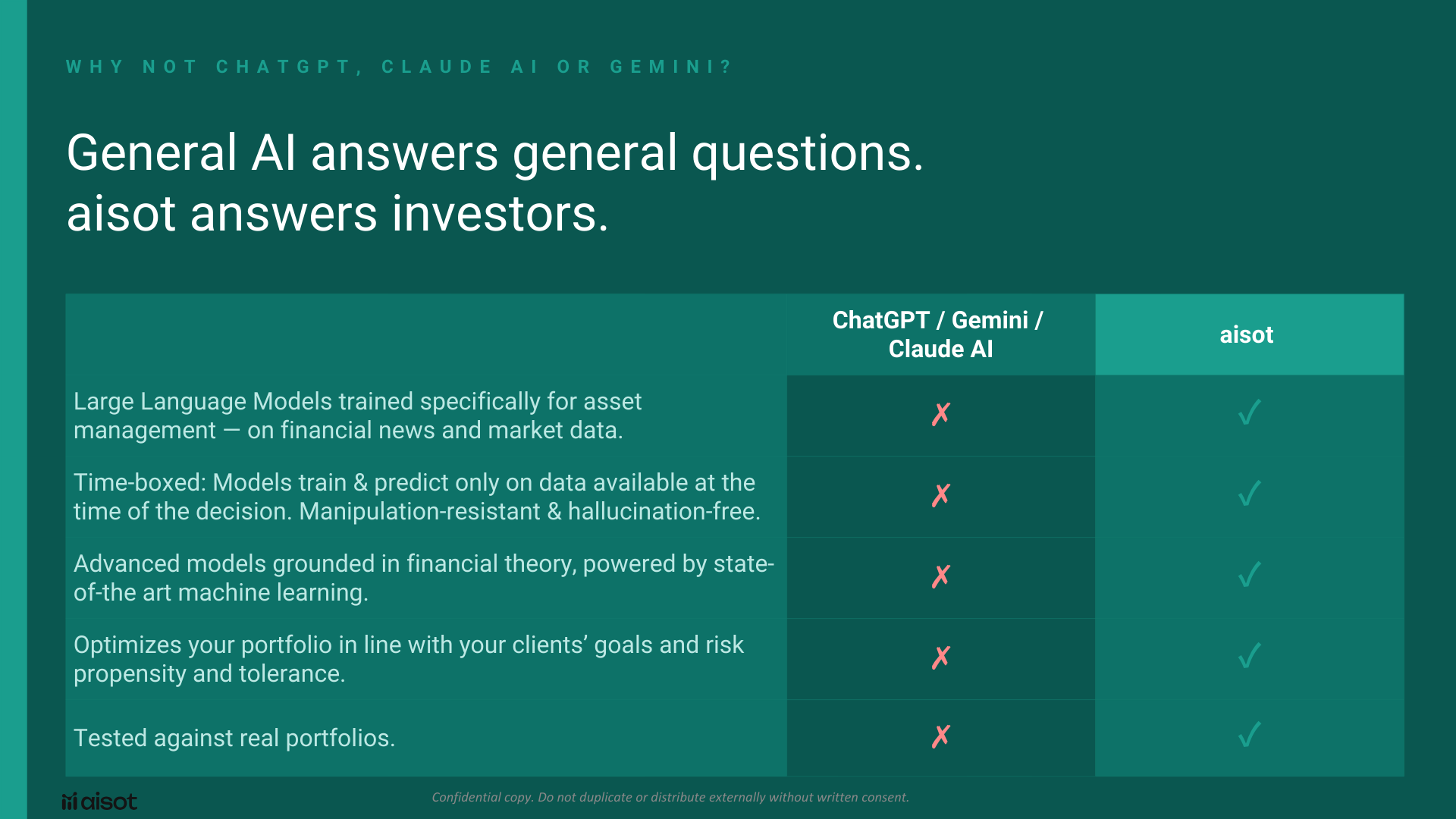
General-purpose models have no access to verified live market data. They cannot account for your current portfolio positions, risk exposure, or recent macro shifts. And critically, they have no built-in protection against hallucination and look-ahead bias. This is the subtle but devastating error of using future information to validate past decisions, which can make a strategy appear far stronger in backtesting than it ever will be in practice.
In most domains, a confident but slightly wrong answer is a minor inconvenience. In investing, it can be costly.
This is not a criticism of general-purpose AI. It is a recognition of what it was built for.
The right tool for the right job
Professional investment analysis requires models built specifically for the financial industry. That is exactly what we set out to build at Aisot Technologies.
Our LLM Eiger is trained exclusively on market signals and strictly limited to information available at the time of each forecast. The result is a model that generates reliable and auditable outputs.
Eiger is developed in three stages:
- Pre-training gives the model a deep grounding in financial language: terminology, market context, and company reports.
- Sentiment fine-tuning then trains it to classify news as positive, negative, or neutral for a given company or asset class.
- Finally, return fine-tuning teaches the model to estimate expected price moves over different horizons directly from news.
Eiger's estimated return forecasts are built for flexibility. Hedge funds and quantitative managers can use them as standalone signals, integrating market-moving news directly into their existing models. Or investment teams can access them through the AI Insights Platform, where signals, portfolio data, and analytics work together to help optimize risk-adjusted returns.
Augmented intelligence
There is a broader point here that often gets lost in the excitement around AI. The goal of financial AI should not be to replace the judgment of experienced investors. It should be to sharpen it, giving portfolio managers better information, faster analysis, and more rigorous risk assessment, while keeping the human firmly in control.
General-purpose AI, however well-prompted, cannot reliably support that process. It lacks the specialization, the data integrity, and the financial guardrails that professional analysis demands.
Warren Buffett has spent decades developing a framework for evaluating businesses. No prompt replicates that. But the right AI, purpose-built, financially trained, and properly integrated into your workflow, can genuinely augment what experienced investors do best.