This year's financial fair FINANZ at the Kongresshaus Zurich left little doubt about where the financial industry's attention is focused: artificial intelligence is reshaping the investment process, from risk management to portfolio construction to day-to-day decision support.
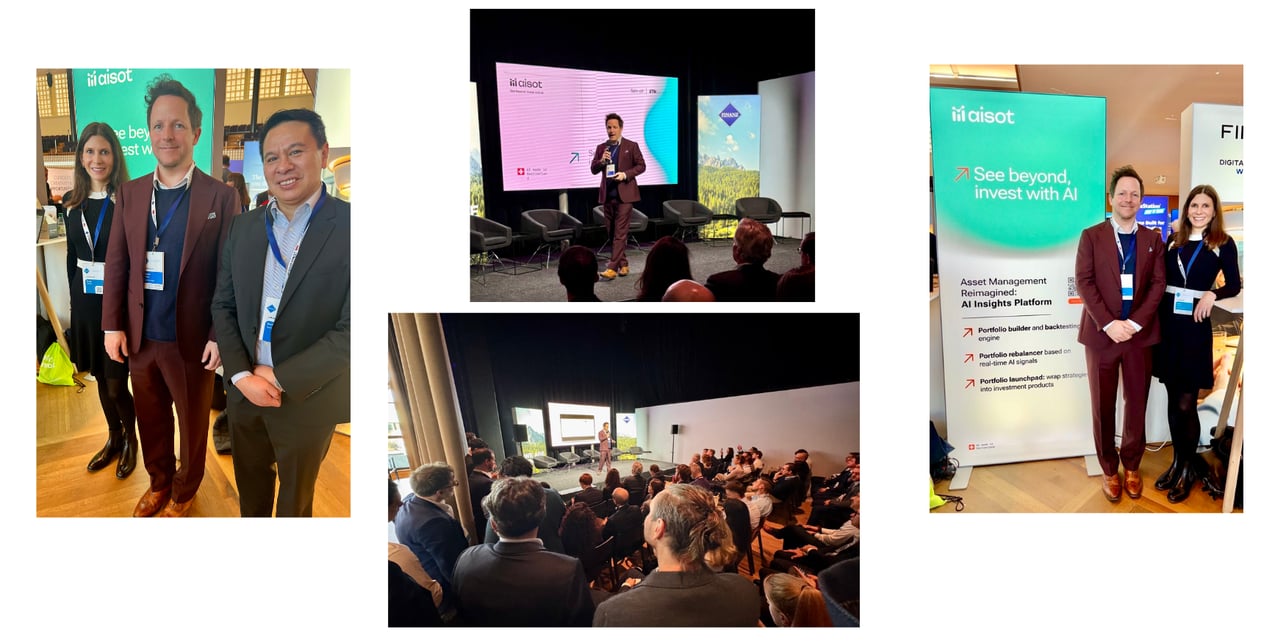
Across panel discussions and presentations, leading voices from across the Swiss and international asset management community came together to explore what this shift means in practice. The lineup included names like Thomas Wille (HWZ), Reda Jürg Messikh (Pictet), Georg von Wyss (BMW Value Investing), Kurt Mooosmann (Swiss Single Family Offices), Stefan Klauser (Aisot Technologies) and Dario Popadic and Reto Germann (Kepler Unigestion). As a diverse group of practitioners and thinkers, they each bring their own perspective on how AI is entering the investment workflow.
The AI-augmented CIO office
A compelling presentation came from Thomas Wille, Chief Investment Officer and lecturer at HWZ, who walked through concrete use cases that bring the AI opportunity into sharp focus.
The first: AI for investment research, bringing the ability to process and synthesize vast amounts of macroeconomic data, news, and signals at a speed and breadth no analyst team can match, giving investment professionals a faster and sharper read, e.g. on the macro environment.
The second was perhaps even more significant: AI for tailored portfolios in asset allocation and portfolio construction. Rather than building model portfolios and fitting clients into them, AI enables a reversal of that logic: portfolios constructed around each client's specific goals and risk profile, with downside risks actively managed and the portfolio continuously adapting to the changing market environment. It's a fundamental shift in what personalization at scale can look like.
Wille was unambiguous about the conclusion: AI is a game changer for the CIO office. It expands both analytical capability and decision-making capacity. But the human remains the central decision maker. In his view, the future belongs to the AI-augmented CIO office. AI won't replace the CIO, but competitive advantage will increasingly go to those who successfully integrate AI into their investment process.
aisot on stage: agentic AI for asset managers
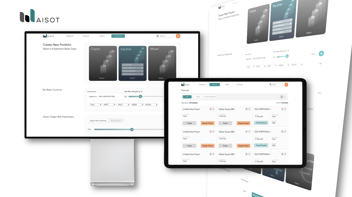
We also saw aisot’s Co-Founder & CEO Stefan Klauser take the stage and share how aisot is bringing agentic AI to asset managers, helping them enhance risk-adjusted performance while keeping the human firmly in control.
A central theme of Stefan's presentation was transparency. Every AI-driven recommendation on the aisot platform comes with plain language insights, so portfolio managers always understand the reasoning behind what the model is suggesting. At aisot, we believe that explainability isn't a nice-to-have. It's what makes AI ready for institutional use and a genuine partner in the decision-making process.
The consensus: augmentation, not replacement
If there was one clear takeaway from FINANZ 2026, it was this: AI will augment the investment process. The human stays in control.
Investment decisions carry real consequences for clients. Trust, accountability, and judgment can't be outsourced to an algorithm. What AI does is handle the heavy lifting: processing vast amounts of data, surfacing signals that would be impossible to identify manually, flagging risks before they materialize, and freeing up portfolio managers and CIOs to focus on higher-order decisions.
The distinction between general-purpose AI and purpose-built financial AI also came up repeatedly. The message was consistent: generic large language models have their place, but investment management demands more. Specialized models like aisot's financial LLMs are trained on financial data and time-boxed to prevent look-ahead bias and hallucination.
A turning point for the Industry
FINANZ 2026 felt like a turning point. Not a moment of speculation about AI's future role in finance, but a practical, grounded discussion about implementation, governance, and measurable results. The questions being asked are no longer "will AI change investment management?" but "how do we deploy it responsibly, and how do we ensure the benefits reach our clients?"
At aisot, those are exactly the questions we're built to answer. We look forward to continuing the conversation.